Author: info@discoverdairy.com
2026 Teacher Appreciation Week: Meet 10 Teachers Who Are Making a Difference
Happy Teacher Appreciation Week! Teachers: THANK YOU for all the energy, support and creativity you pour into your classrooms every day. Our Discover Dairy teachers have a strong passion for agriculture, so this week, we want to showcase a few who are going above and beyond for their students and communities. Thank you to everyone who submitted nominations for this spotlight series! We know our teachers are the heart of our school communities, and we are inspired by the difference you are making.
Meet Jennifer France
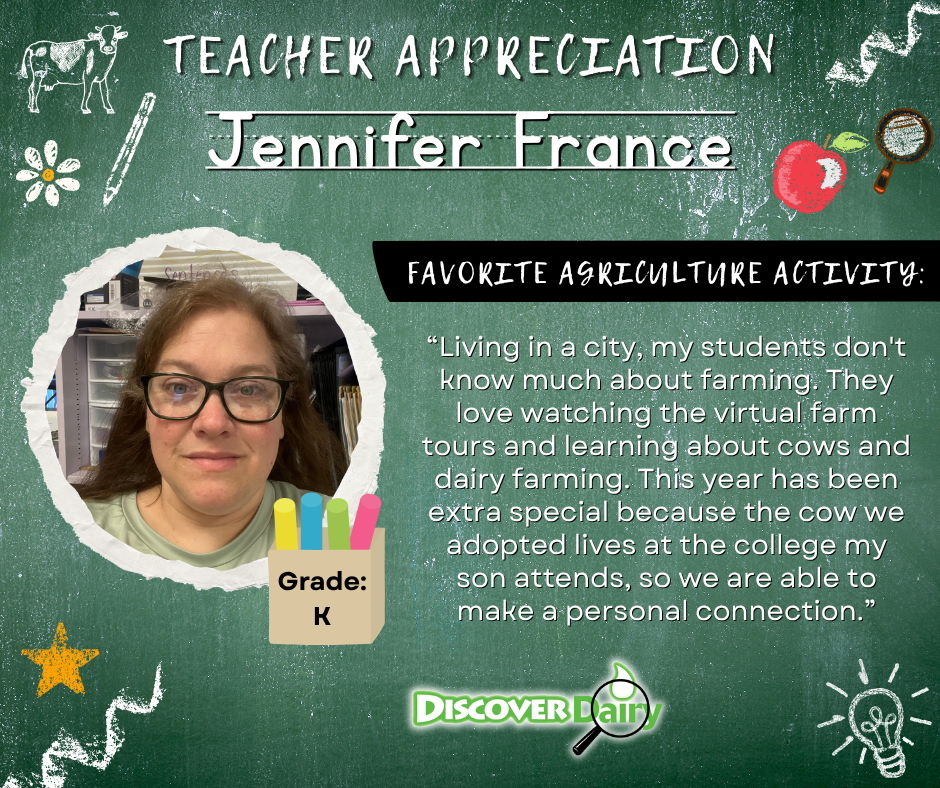
Meet Jennifer France, a kindergarten teacher at Indian Hills Elementary in Arkansas. Her purpose is to be an always-available resource, helping to bridge gaps in information and support. The chance to shape future generations and make a lasting social impact is a powerful motivator. As a teacher for 25 years, she loves watching kids grow throughout the year and the smiles on their faces when they realize they are reading, writing, doing math, and becoming scientists. By having them in kindergarten, she gets to watch them grow from the beginning and cheer them on.
Living in a city, Jennifer uses the Adopt a Cow program to help her students learn about farming and the importance of farms in their everyday lives.
What’s her favorite agriculture activity? “My students don’t know much about farming. They love watching the virtual farm tours and learning about cows and dairy farming. This year has been extra special because the cow we adopted lives at the college my son attends, so we are able to make a personal connection.”
Meet Alexa Brown
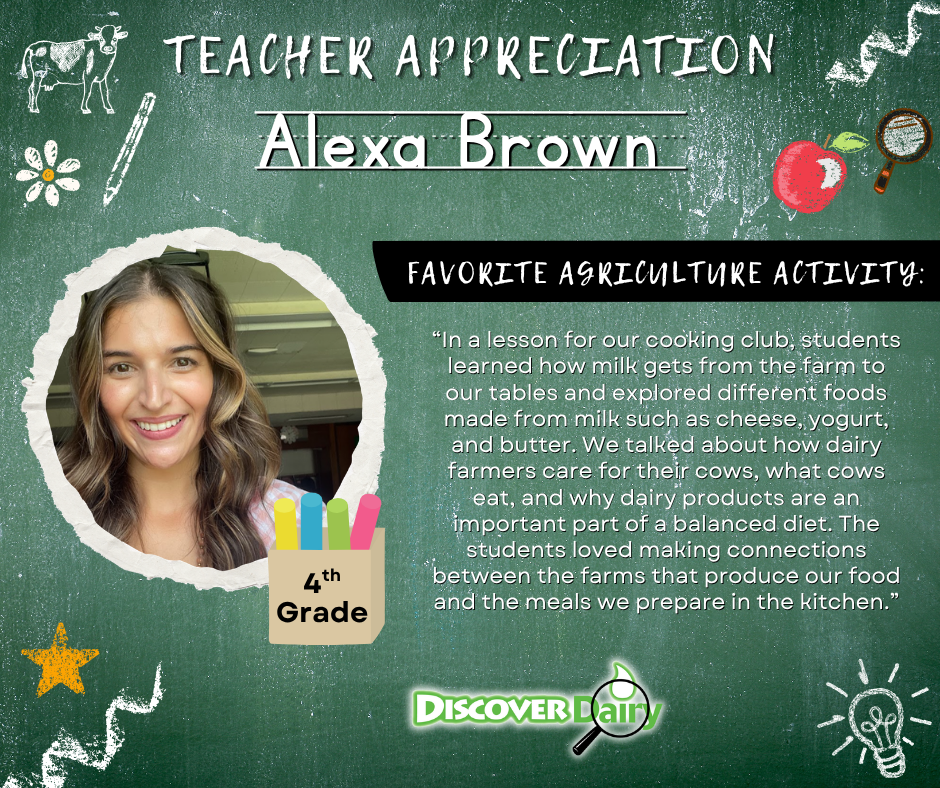
Meet Alexa Brown, a fourth-grade teacher at Thomas Hooker Elementary in Connecticut. Growing up with a learning disability, school was often a place where Alexa doubted herself and felt like she wasn’t as capable as the other kids. That changed in fourth grade when her teacher took the time to truly believe in her. That support made a lasting impact on her confidence and how she saw her own potential. It inspired Alexa to become a teacher so she can have that same meaningful impact—helping students feel seen, supported, and capable of achieving more than they ever thought possible.
One of her favorite memories was organizing the first cooking club at her school called Sprout Scouts with a FoodCorps teacher. It was a rewarding experience to watch students get excited about learning in a hands-on way. During the club, kids learned how to cook simple recipes, explore new fruits and vegetables, and understand the importance of healthy eating and creating balanced meals. She builds on this idea by using the Adopt a Cow program and helping today’s generation understand where their food comes from.
What’s her favorite agriculture activity? “During a lesson for our cooking club, students learned how milk gets from the farm to our tables and explored different foods made from milk such as cheese, yogurt, and butter. We also talked about how dairy farmers care for their cows, what cows eat, and why dairy products are an important part of a balanced diet. The students loved making connections between the farms that produce our food and the meals we prepare in the kitchen.”
Meet Lindsey Brown
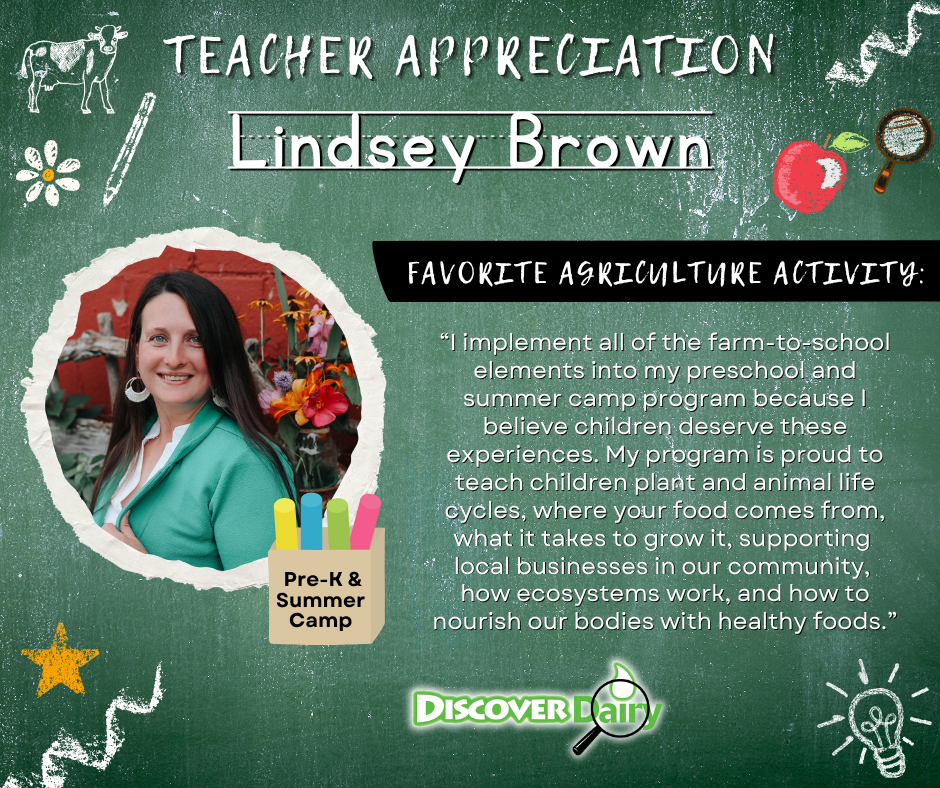
Lindsey Brown’s inspiration came from her own children, raising them on a hobby farm and watching them learn where food comes from. That’s what helped her decide to open Browns Family Childcare in Pennsylvania, a nature-based program where children could learn, grow and thrive outside. When her family had baby cows, families in her program would visit in the evenings so their children could bottle-feed the calves. Many years later, these families still talk about these experiences.
Lindsey also has a sharing station where anyone enrolled can take or leave seed packets, produce or other foods that are aplenty. They recently completed a fruit tree study where they taste-tested their own apple, peach and pears from trees on the farm.
What’s her favorite agriculture activity? “I implement all of the farm-to-school elements into my preschool and summer camp program because I believe children deserve these experiences. From local food procurement to growing our own foods, my program is proud to teach children plant and animal life cycles, where your food comes from and what it takes to grow it, supporting local and small businesses in our community, how ecosystems work, and most importantly, how to nourish your bodies with healthy foods.”
Meet Maria Young
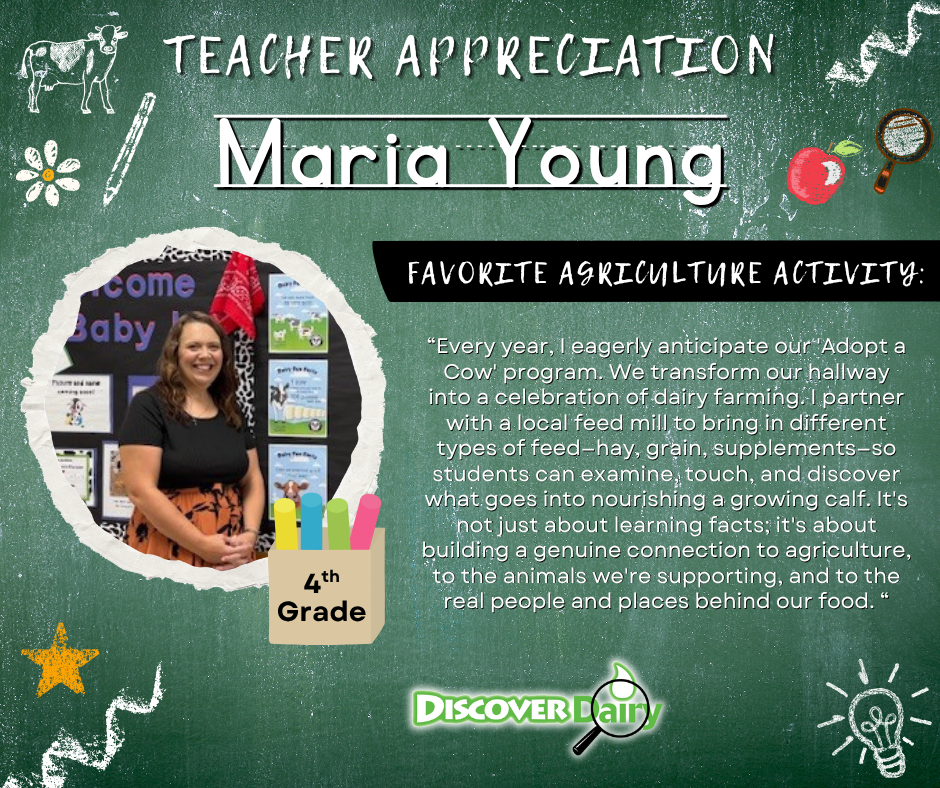
Meet Maria Young, a fourth-grade teacher at Providence Elementary in Pennsylvania. As a child, Maria’s teachers encouraged her when she doubted herself, challenged her to think bigger, and gave her the confidence to believe she could do hard things. That’s when it clicked for her: teachers don’t just shape what students learn; they shape who students become. She realized she wanted to be that person for others. Maria’s favorite memory is hatching chicks in her classroom for the first time. She designed an entire embryology unit, and the anticipation was palpable—they had a countdown on the bulletin board, candled the eggs, and built excitement day after day. When those first chicks finally broke through their shells, the energy in the classroom was electric!
Growing up on a dairy farm, Maria is passionate about agriculture. She uses the Adopt a Cow and Discover Dairy programs to share share that passion with her students. Many of her students live in a rural community and see farms every day—but they don’t truly understand them. Discover Dairy has changed that and helped her students move beyond simply observing farms to genuinely understanding them: the science, the care, and the dedication involved.
What’s her favorite agriculture activity? “Every year, I eagerly anticipate our ‘Adopt a Calf’ program—it’s one of the highlights of my teaching year. We transform our hallway into a celebration of dairy farming: a vibrant bulletin board showcases stunning farm photography, tracks our calf’s growth month by month, and features memories from past years. What truly captivates my students is our hands-on exploration of cattle nutrition. I partner with a local feedmill to bring in different types of feed—hay, grain, supplements—so students can examine, touch, and discover what goes into nourishing a growing calf. It’s not just about learning facts; it’s about building a genuine connection to agriculture, to the animals we’re supporting, and to the real people and places behind our food.”
Meet Johnathon Dietrich
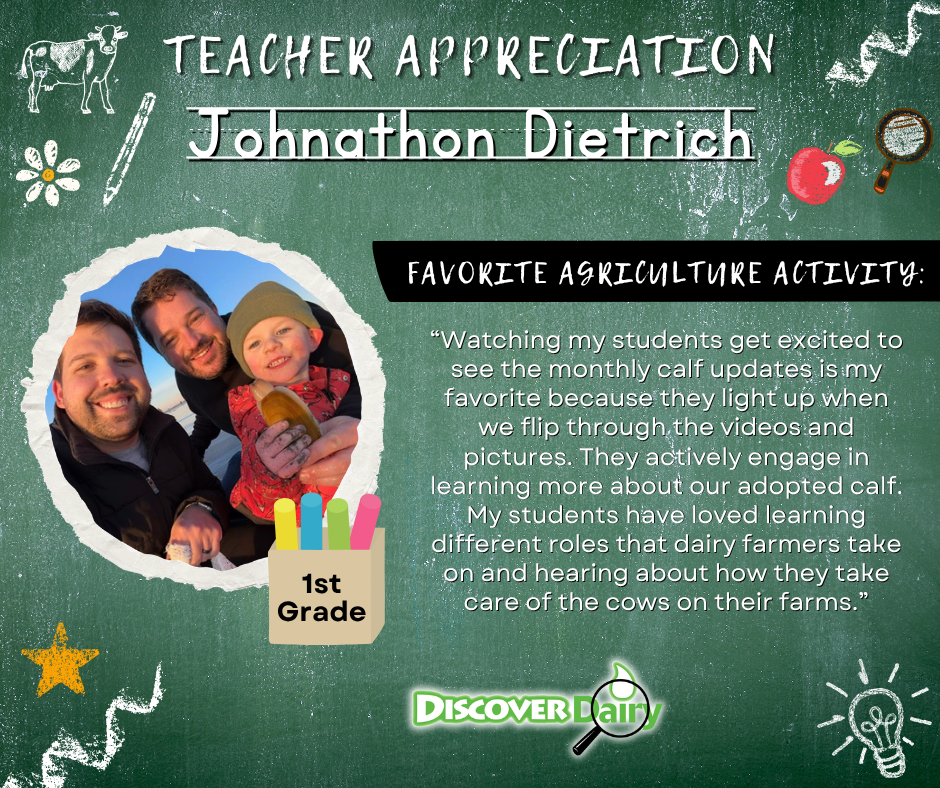
Meet Johnathon Dietrich, a first-grade teacher at John Campbell Primary in Wisconsin. Johnathon’s inspiration comes from the teachers who saw potential in him long before he could see it in himself. For him, the most impactful moments as a teacher are watching as students truly understand a new concept they are learning — when you see the lightbulb click above their head and they get so excited. Johnathon’s favorite memory is seeing his class grow into a secondary family. Some of his students might have rough lives, but the moment they get comfortable in the classroom and really settle in, their worries melt away.
The Adopt a Cow program has given his students lasting memories and helped them learn so much about dairy farming throughout the school year.
What’s his favorite agriculture activity? “Watching my students get excited to see the monthly calf updates is probably my favorite thing to come out of it because they genuinely light up when we flip through the videos and the pictures. They actively engage in wanting to learn more about our adopted calf, Dottie Moo. They have loved learning different roles that dairy farmers take on and hearing about how they take care of the cows on their farms.”
Meet Nina Gushka
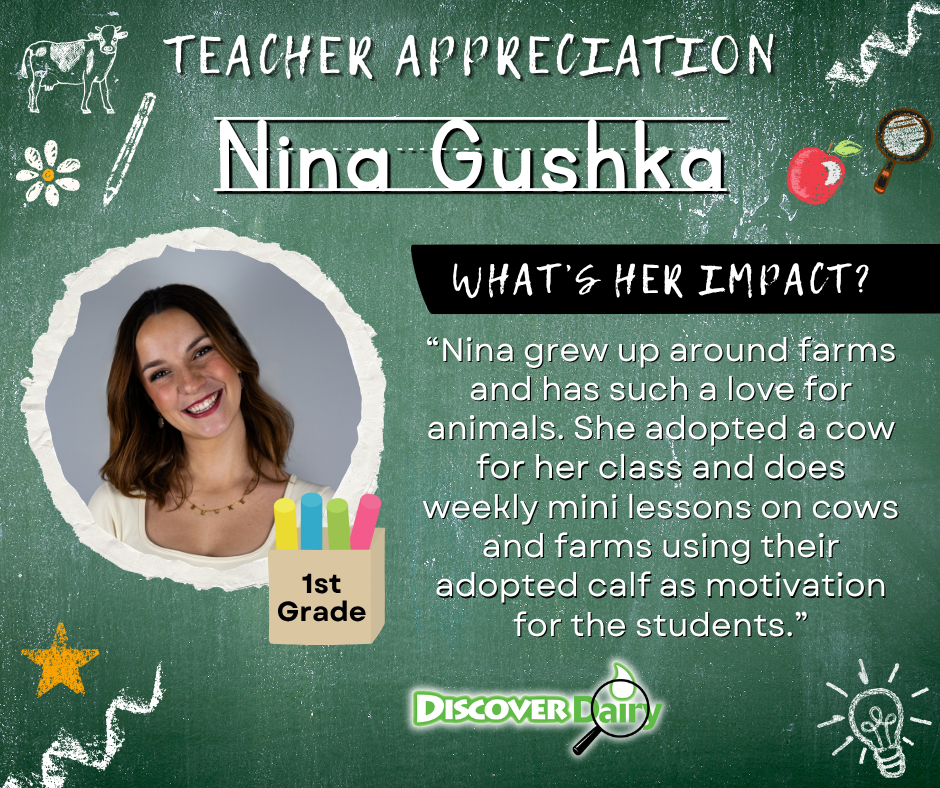
Meet Nina Gushka, a first-grade teacher at Wyoming Valley in Pennsylvania. Nina goes above and beyond for her classroom. She is always finding new ways to keep learning engaging and fun for her students while still learning something new. She will always advocate for what is best for her students to ensure they have a successful future. She gets them gifts every holiday and is always loading a cart with snacks to give them so no child is hungry in her classroom. While this job challenges her every day in different ways, Nina always finds a solution to whatever problem is presented and goes in each day with a smile on her face.
What’s her impact? “Nina grew up around farms and has such a love for animals. She adopted a cow for her class and does weekly mini lessons on cows and farms using their adopted cow, Fudge, as motivation for the students.”
Meet Mrs. Lambrecht
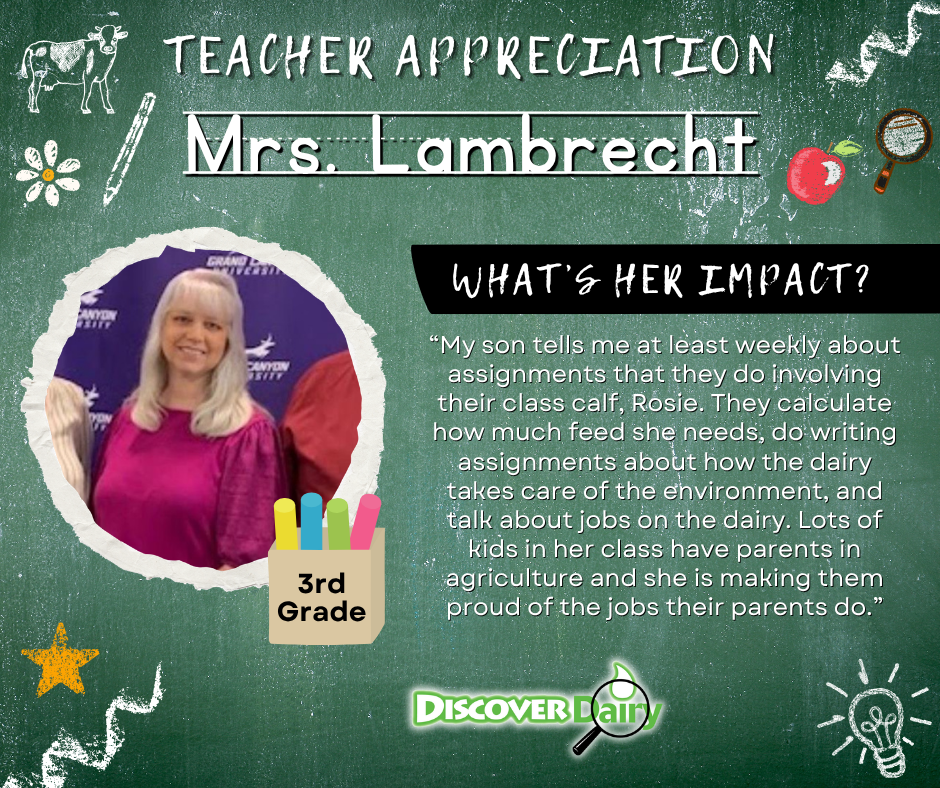
Meet Mrs. Lambrecht, a third-grade teacher at Palo Verde Elementary in Arizona. She genuinely cares about getting kids prepared for a successful future. Mrs. Lambrecht goes above and beyond, volunteering to be a student’s teacher while the student was hospitalized with leukemia and giving up her prep hour for two years so that the student could stay with her class when she got better.
Mrs. Lambrecht does an amazing job preparing her students for the future and also does a great job highlighting the importance of dairies and agriculture.
What’s her impact? “My son tells me at least weekly about assignments that they do involving their classroom’s adopted calf, Rosie. They calculate how much feed she needs, do writing assignments about how the dairy takes care of the environment, and talk about jobs on the dairy. Lots of kids in Mrs. Lambrecht’s class have parents in agriculture and she is making them proud of the jobs their parents do.”
Meet Tyler Gentry
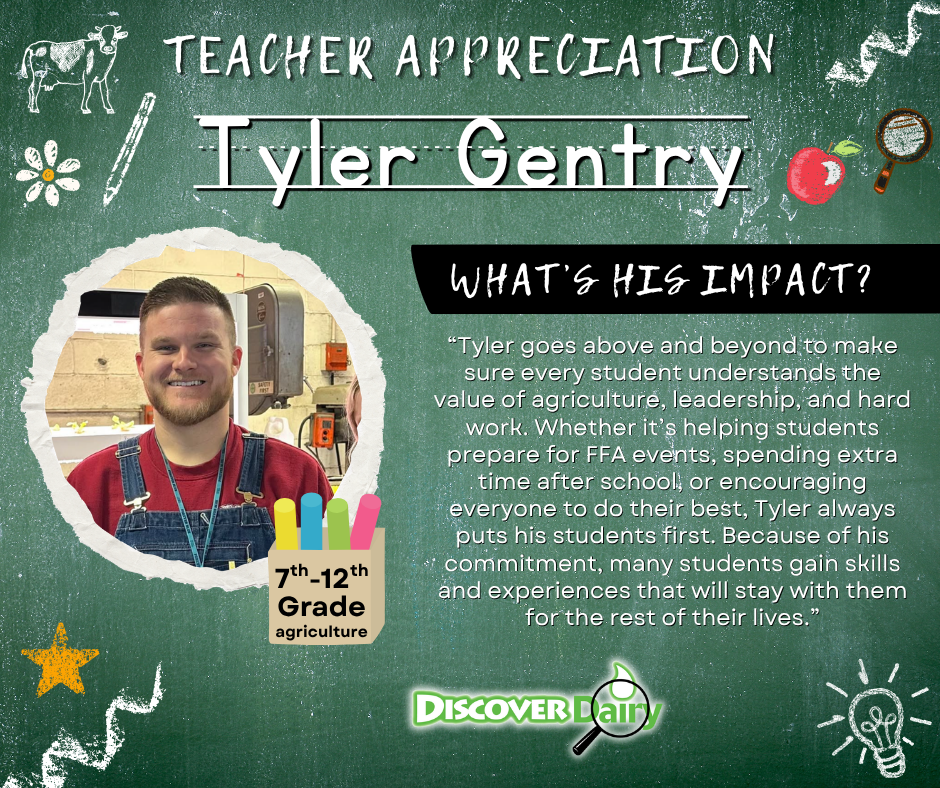
Meet Tyler Gentry, a “Vo-Ag” teacher for 7th through 12th graders at United Local Middle & High Schools in Ohio. Tyler is dedicated to the Vo-Ag program and shows constant support for his students. His entire curriculum is livestock husbandry. Students have their own hydroponic system where they grow their own vegetables, and he does an aquaponics system where students raise fish along with the vegetables to see how they interact. Tyler is also very active and spearheads United Local’s FFA chapter. He sets up local businesses to visit with students and educate them about their future career options in farming.
Tyler also makes time to give back, leading a community outreach effort every year to get families a turkey meal for the holidays who might not otherwise have one.
What’s his impact? “Tyler goes above and beyond to make sure every student understands the value of agriculture, leadership, and hard work. Whether it’s helping students prepare for FFA events, spending extra time after school, or encouraging everyone to do their best, Tyler always put his students first. His passion for agriculture and teaching inspires students to learn, grow, and become confident leaders. Because of his commitment, many students gain skills and experiences that will stay with them for the rest of their lives.”
Meet Carter Nothaft
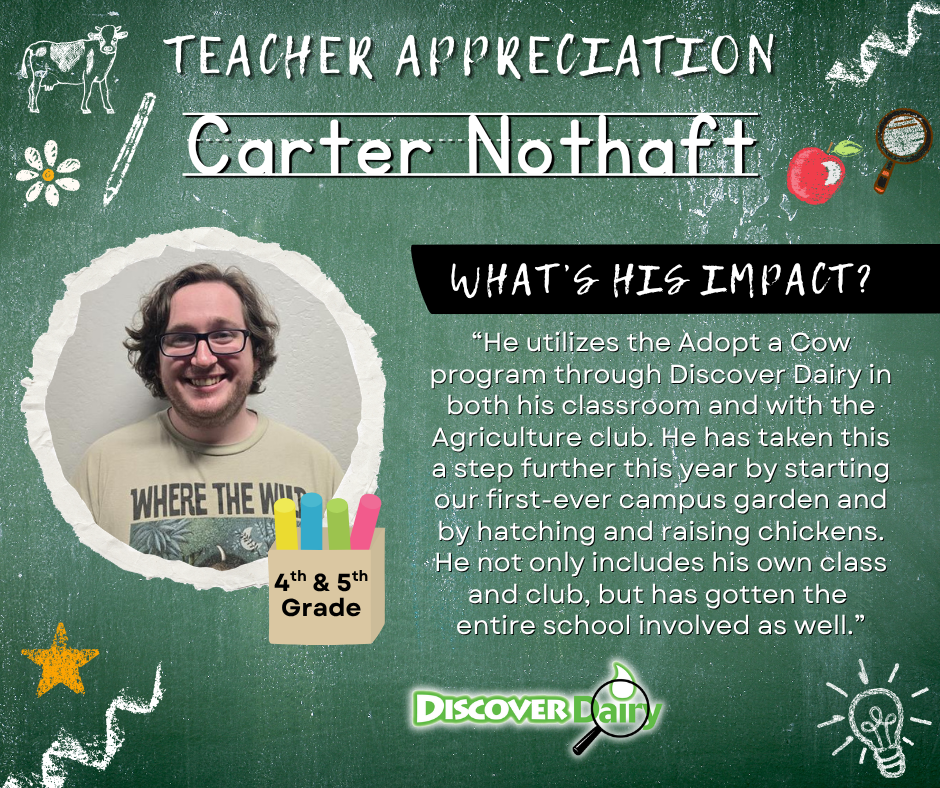
Carter Nothaft is a fourth-grade engineering and agriculture club teacher at BASIS Ahwatukee in Arizona. He is an incredible first-year teacher and primarily teaches Engineering to fourth graders on campus. Carter truly shows students what it means to care about the world and those around you. He also runs the Agriculture club on campus for fourth and fifth graders. This year, he went above and beyond and took the Adopt a Cow program to the next level. Most of his students have never had any sort of exposure to agriculture or farming practices. This has not only allowed them to learn more but to become more curious about everything around them.
What’s his impact? “Carter utilizes the Adopt a Cow program through Discover Dairy in both his classroom and with the Agriculture Club. He has taken this a step further this year by starting the first-ever campus garden and by hatching and raising chickens. He not only includes his own class and club, but has gotten the entire school involved as well.”
Meet Taylor Captain
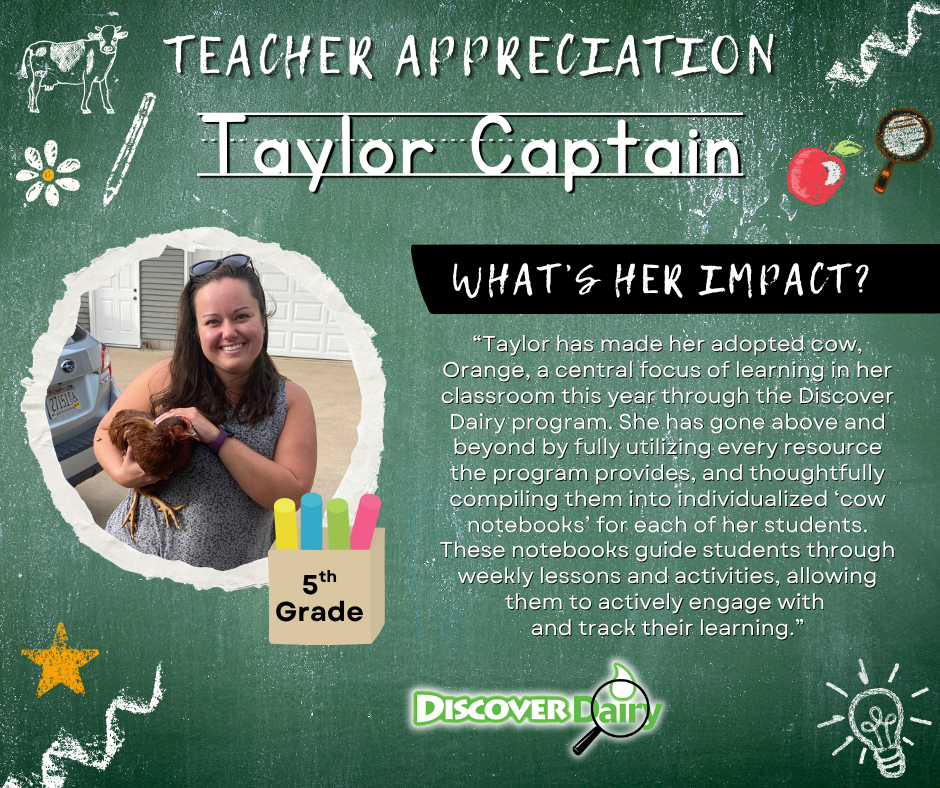
Meet Taylor Captain, a fifth-grade teacher at Maplewood Intermediate in Wisconsin. One of the most unique and impactful aspects of Taylor’s teaching is her genuine passion for agriculture and animals. She brings this love into her classroom, helping students build an appreciation for farming, food systems, and where their food comes from. Over the past year, she has even begun raising her own chickens, further deepening her connection to agriculture and modeling lifelong learning for her students. Through the Adopt a Cow program, Taylor has created meaningful opportunities for students to explore various aspects of agriculture, including dairy farming, animal care, and the journey of food from farm to table. Her intentional planning and enthusiasm have made these lessons both educational and exciting, sparking genuine curiosity and interest among her students.
What’s her impact? “Taylor has made her adopted cow, Orange, a central focus of learning in her classroom this year through the Discover Dairy program. She has gone above and beyond by fully utilizing every resource the program provides, thoughtfully organizing and compiling them into individualized “cow notebooks” for each of her students. These notebooks guide students through weekly lessons and activities, allowing them to actively engage with and track their learning.”
Nominate Someone for 2026 Teacher Appreciation Week
We’re celebrating MOO!
As we approach Teacher Appreciation Week this May, we’re looking for teachers to spotlight who have a passion for agriculture. We want to showcase all the time, energy and passion you pour into your classroom and students throughout the year. It’s truly worth celebrating!
Submit your information by March 31, 2026 for a chance to be spotlighted on our channels during Teacher Appreciation Week this May! Don’t like to be in the spotlight? Nominate a deserving colleague or friend! Click here to submit your nomination. The nomination form should only take a few minutes to complete. Note: If you were spotlighted last year, you are not eligible to be spotlighted this year.
Win a Teacher Appreciation Week Prize Pack: As a fun incentive, the teachers who are selected to be spotlighted this May will receive a prize pack to celebrate your classroom success with your students the first week of May. Prize packs will include gifts for you and gifts for your students to celebrate together! Nominations will be reviewed after March 31, and winners will be announced by mid-April.
Note: By submitting a nomination, your responses may be shared on our social media channels.
Meet Daniel and Jeffrey: Instructors in PA Prisons Who Are Planting Seeds and Offering a Little Bit of Peace
This story is part of a series of “meet & greets” with individuals who use our Adopt a Cow program to inspire you with the endless ways you can incorporate the program in the classroom and beyond!
While Discover Dairy’s Adopt a Cow Program is usually utilized in an elementary classroom setting, two instructors from Pennsylvania prisons have discovered meaningful ways to introduce the program and make agriculture connections with their inmates.
Daniel Nicklen, an ABE Teacher in the Department of Corrections in Albion, PA, has inmates of all ages – mainly 22 and up – who take general education classes with him.
“I teach in a classroom inside the prison. Each prison in Pennsylvania is set up like a small town, and that includes an education building with general education classes, vocational classes, a library, guidance counselor and principal,” Daniel shared. “I’m able to teach any of the core subject areas such as ELA, Math, Science, Social Studies, Health and Financial Literacy. In this prison, we have a large mental health population so I work a lot with those inmates given my background with special education.”
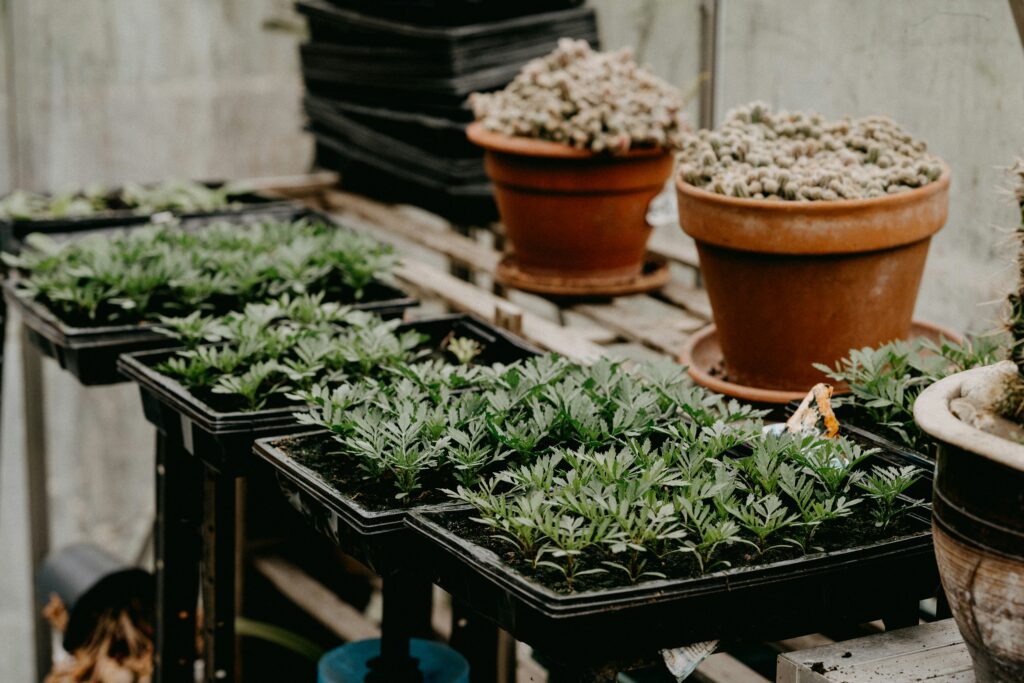
For Jeffrey O’Hara, a Horticulture Vocational Trade Instructor at the United States Penitentiary Canaan, he works with adult male, primarily white-collar offenders. Most are older than 25 and come from all walks of life. After hearing about the Adopt a Cow program, he thought it would help bring a sense of meaning and excitement to his horticulture class – while raising awareness about entry-level job opportunities in agriculture once inmates are released.
“They can sign up for my horticulture class. It’s a 200-hour class and it’s just basically an introductory program to horticulture. The Adopt a Cow program has very diverse subject content,” Jeffrey explained. “We tie in a little bit of the program with the growing of plants. We talk about how farmers grow corn to feed cows, different types of grain, and of course pasture grass and stuff like that.”
Introducing them to a new industry
With many of the prison’s inmates coming from inner cities, learning about cows is new to them.
“Some of my students lived in cities. They may never have seen or touched a cow or knew that’s where milk comes from. They don’t know any of the technical aspects that go into farming like the housing, bedding, and how fast the animals grow,” Jeffrey said.
With each classroom being paired with a calf from a Pennsylvania dairy farm, Daniel and Jeffrey receive regular photo updates, dairy facts, activity sheets, and other resources that help explain the calf’s growth, how the farmers care for her, and more.
“I have a bulletin board that I have dedicated to the program in the classroom. I mainly incorporated the program into my biology class, but students from other classes have been interested,” Daniel shared. “Usually when we get the monthly updates, I’ll share all the photos with the students on my projector which will usually lead to questions that we discover together as a group if I’m unable to answer it myself. I’m thankful there is a program out there to teach about agriculture in PA.”
For Jeffrey, the program is helping him introduce new concepts to his students about the science and technology that goes into farming.
“The biggest thing I use from the program is the dairy fun facts. I usually do that with every class and they’re very surprised that a cow can drink a bathtub full of water a day, for example, or how much the calf has grown. I believe the inmates do get information out of it,” Jeffrey added. “I also have the growth sheet provided by the program in case they want to compare how tall the cow is compared to how tall they are. I tell them how farmers need to have mechanical knowledge and computer knowledge, too. It’s just not planting seeds in the dirt anymore.”
Helping them connect with their families
Both Daniel and Jeffrey say the Adopt a Cow program has also allowed inmates to connect with their families and children outside the facilities.
“I know that many of the students have family/children outside the facility that they share what they’re learning. They’ve shared the website so they can also view the program,” Daniel said.
“Adopt a Cow is giving them a background that they can maybe tell their kids or grandkids about – share some fun facts about a cow or share what we talked about in class,” Jeffrey added.
Offering a little bit of peace
Beyond fun facts and knowledge about agriculture, the Adopt a Cow program has helped give the students something to look forward to and a bit of “mental first aid” – two monumental things for inmates.
“The Adopt a Cow program has engaged them to ask questions and have something to look forward to [in my class]. Many of the students are forced to come to school due to the lack of a GED/high school diploma if they didn’t enter into the system with one,” Daniel said.
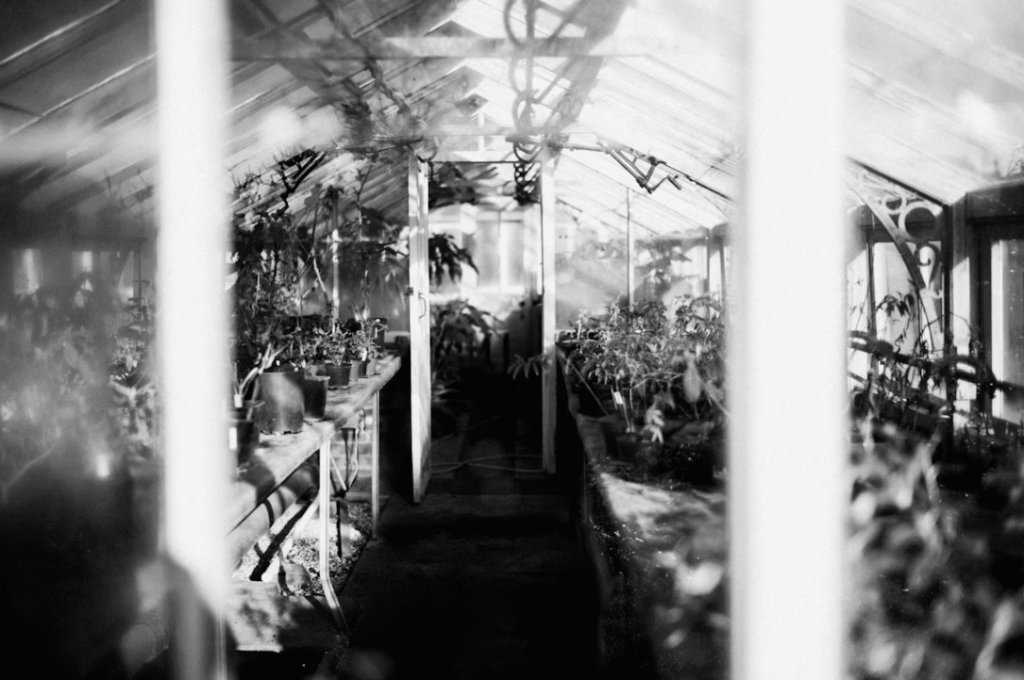
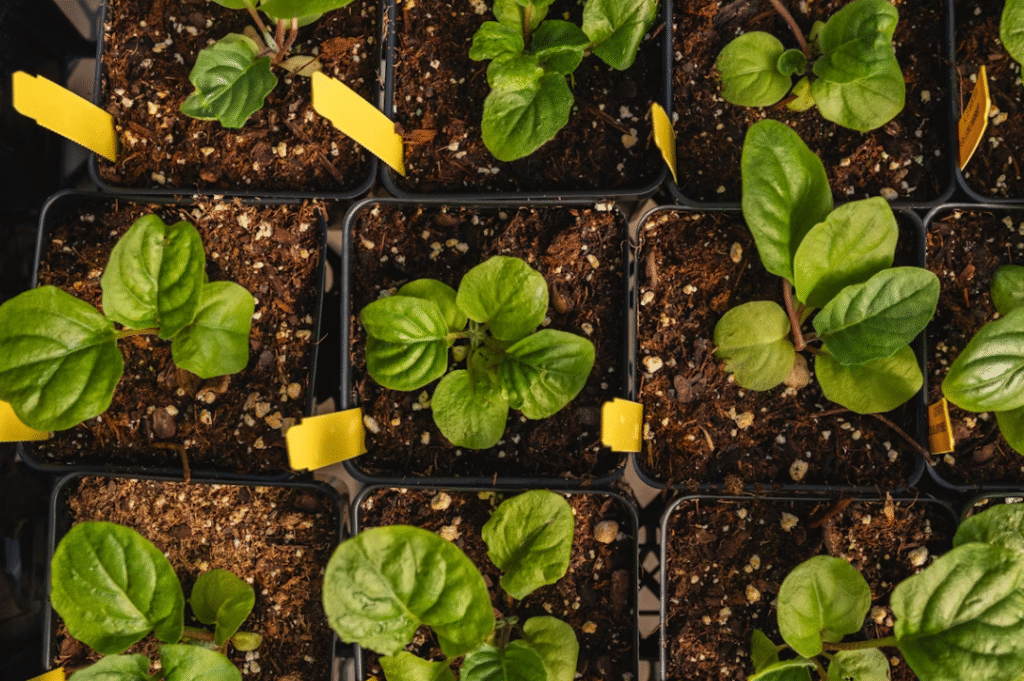
“This class gives them a little bit of peace away from life in the prison. There’s a lot of politics since they live in a dorm setting. It’s like a little city in itself, so when they come over to the greenhouse for class, it gets them away from the politics. It’s kind of like mental first aid and plant therapy,” Jeffrey shared.
Opening their eyes to job opportunities
With many dairy farms experiencing labor challenges, the Adopt a Cow Program is helping the inmates learn about potential, entry-level job opportunities once they are released.
“The program has raised awareness of job opportunities after release, since these guys don’t have a lot of options. I’m not sure how many students are aware of jobs in agriculture, so this has been a great introduction for that. I would like to expand on this topic for next year and see if there is any way to have more agricultural industries involved in our re-entry fair,” Daniel shared.
“The connection for job skills when they get out is definitely important. When they are released from prison, they need to have a job skill so they can get employed and don’t fall back into a life of crime again,” Jeffrey said. “They only know the lifestyle they had before they came in. Hopefully taking this horticulture program changes their life and gives them a skill to help them find a life-sustaining wage.”
What is the most rewarding part about working in a prison setting and helping to make these connections with inmates?
“In our case, when an inmate plants let’s say a marigold seed, it’s small and they put it in the dirt. Then, 10 days later, it comes up and the inmates realize, ‘Wow, I did that.’ Then, he takes that and they’re transplanted into a cell pack. Then, he takes that cell pack and transplants it into the landscape bed. It gives them a sense of meaning,” Jeffrey shared. “That, of course, brings joy to me that I was able to make that connection and show them how to do this from start to finish.”
Discover Dairy is an educational series managed by the Center for Dairy Excellence Foundation of Pennsylvania in partnership with American Dairy Association Northeast, American Dairy Association Indiana, Midwest Dairy, The Dairy Alliance, Dairy Farmers of Wisconsin, Dairy Management West, Dairy West, New England Dairy, Dairy Farmers of Washington, American Dairy Association Mideast, Dairy Council of Florida, United Dairy Industry of Michigan, Maine Dairy and Nutrition Council, and Oregon Dairy Council.
Meet Monica: New York Teacher Who Guides Student-Led Dairy Drive to Address Food Insecurity
This story is part of a series of “meet & greets” with individuals who use our Adopt a Cow program to inspire you with the endless ways you can incorporate the program in the classroom and beyond!
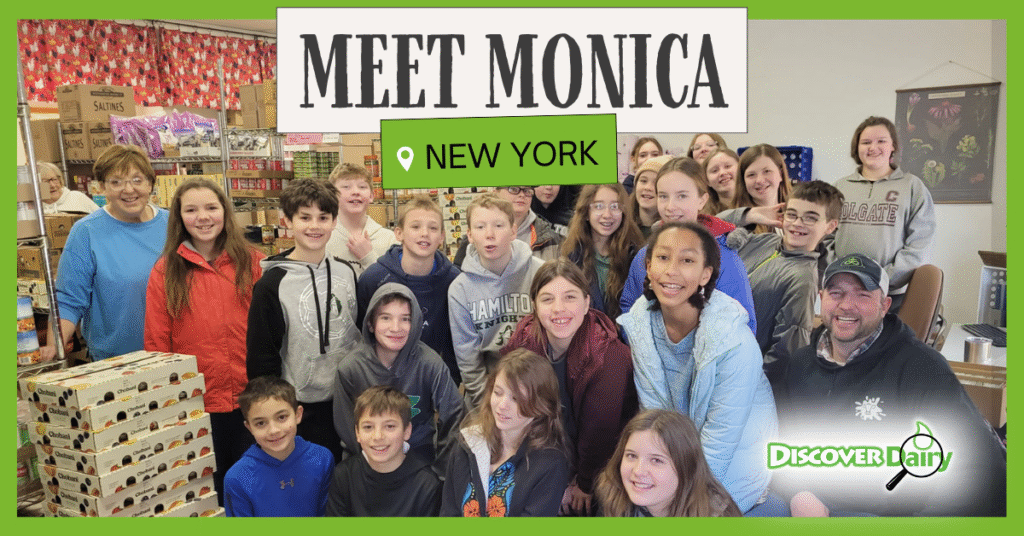
Monica Chamberlain, a sixth-grade teacher from New York, is not only passionate about agriculture, but she works to give her students opportunities to solve real-world problems such as food insecurity. With her passion for project-based learning, Monica encourages her students to talk about real problems affecting their community and develop their own solutions. This is what kickstarted the student-led Dairy Drive in her classroom, where students sell paper cows to raise money to get milk into their local food cupboard for an entire year.
“We started talking about food insecurities and what it means to be food insecure. Students wondered if we have that here in our community. We did some research, and the kids quickly found out that a lot of our community relies on our food cupboard. From there, we dug into what does that mean and where is our food cupboard located?” Monica shared.
Students led the process, reaching out to the director of the food cupboard and asking their own questions. A key question they asked was: what items are frequently donated, and what items do the people who use the food cupboard truly need? They learned milk was the most requested item, but it was the least donated because it’s not shelf stable.
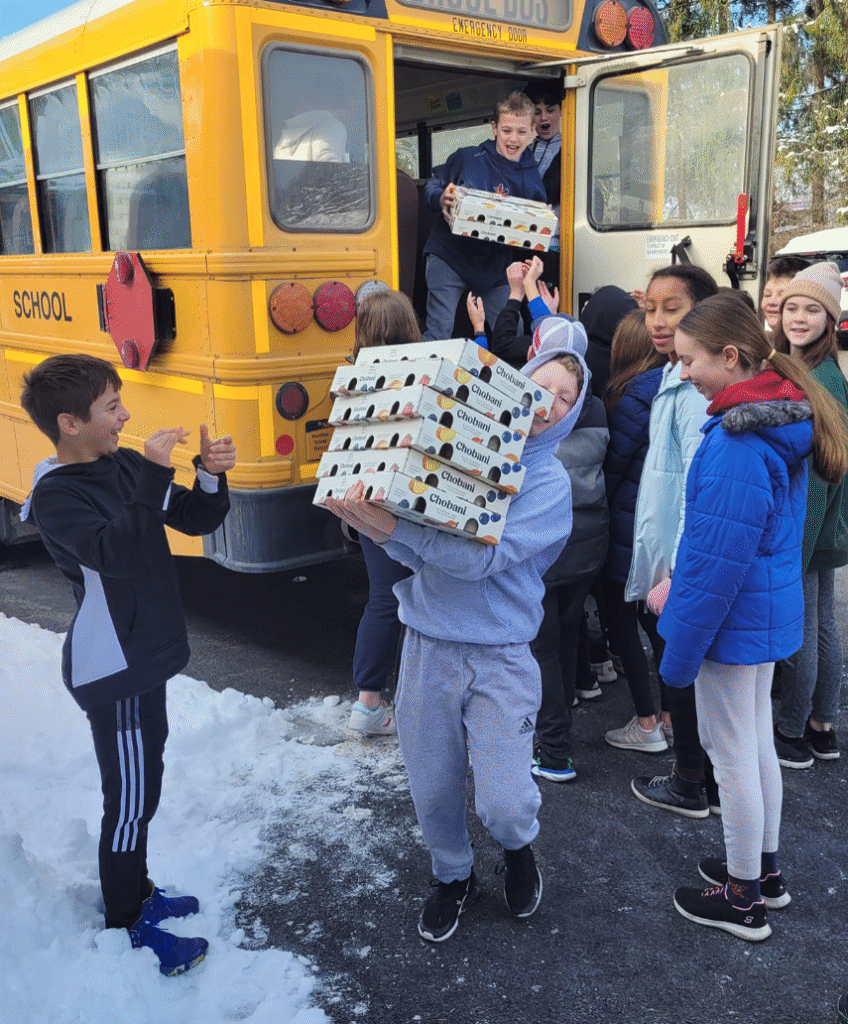
“From there, our driving question became how do we get milk into the food cupboard? The kids started brainstorming. I started reaching out to different organizations like American Dairy Association Northeast. They gave us paper cows, and the kids sell them for a dollar. Every single bit of our proceeds goes to purchasing milk,” Monica added.
Her students took it a step further and figured out a way to ensure it was local milk they were purchasing and sending to the food cupboard.
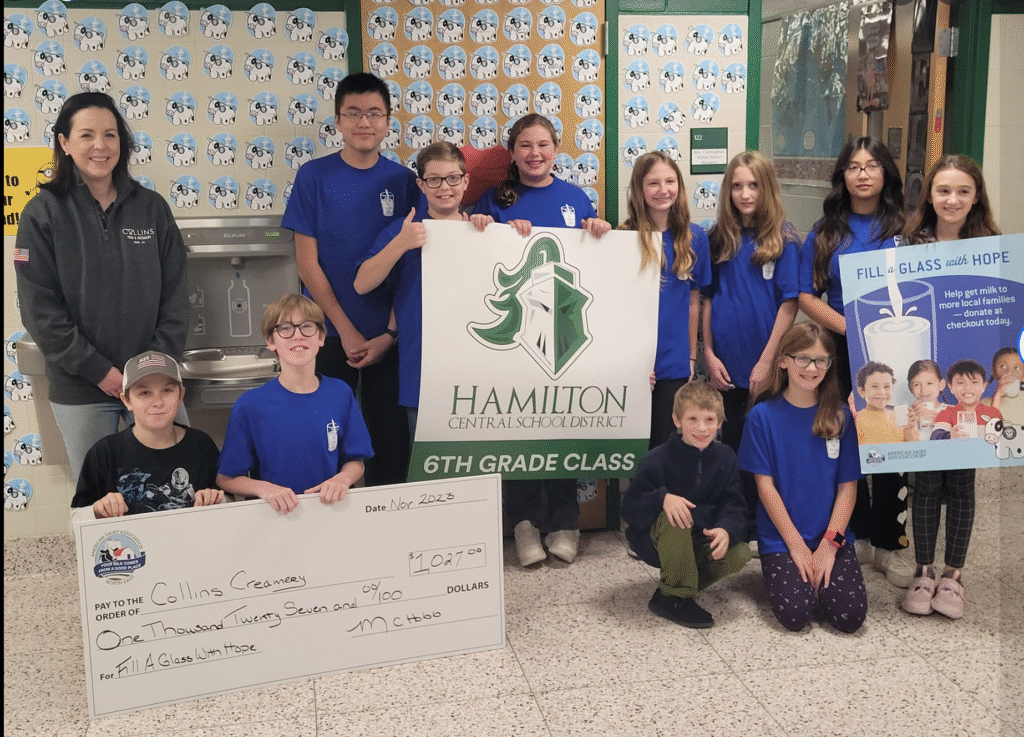
“Students really wanted their money that they were working hard to collect to stay local and support a local farm. They decided to purchase our milk from Collins Creamery, right here in Rome, New York. The farm bottles their own milk and sells everything right on their farm,” Monica shared. “The kids worked with the farm, came up with a delivery schedule, and worked with the food cupboard on how many they should deliver at a time.”
During the first year of the Dairy Drive, her students raised about $400. The second year, the group raised even more and were able to support additional people in their community.
“The kids set a goal to get milk in the food cupboard for an entire year. We were two weeks shy, which is really disappointing, but we raised a ton of money. They were able to get milk not only in our food cupboard for almost the entire year, but they raised so much money that we actually started donating milk to a local assisted living facility for senior members,” Monica said.
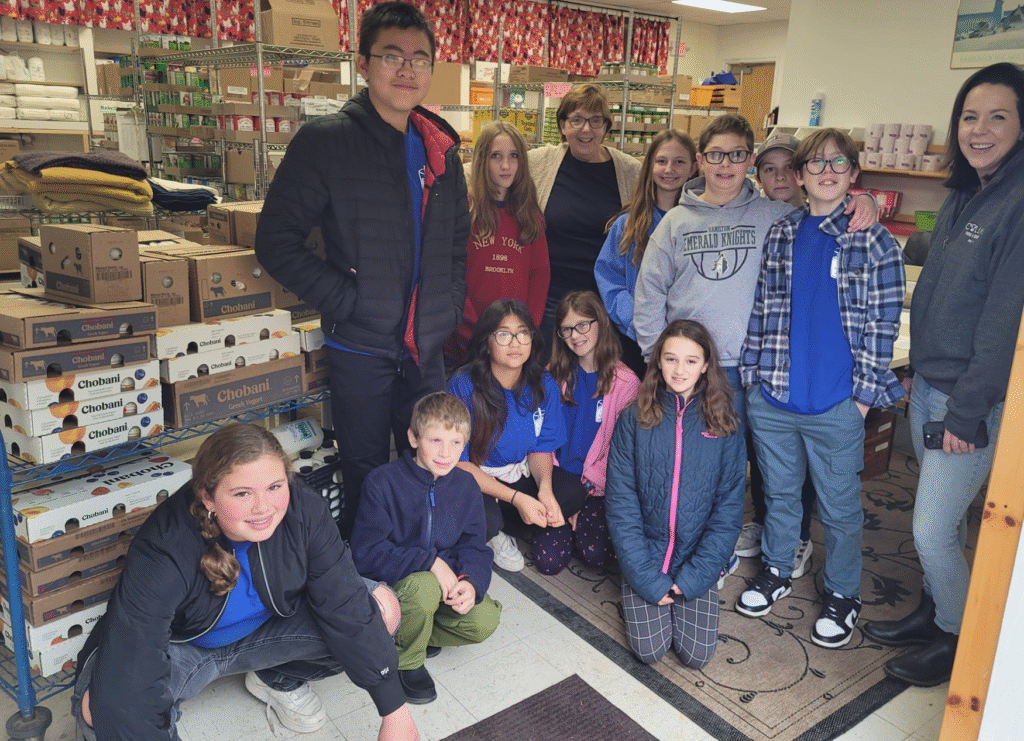
Beyond supporting their community, Monica’s students have been learning real-world business skills such as:
- Making phone calls and email communication. “Any phone calls that needed to be made, the kids were making them. Any emails that needed to be sent out, the students were sending them.”
- Coordinating with businesses and arranging delivery timelines. “We partnered with Chobani on this Dairy Drive as well, and Chobani donated flats of yogurt and cases of drinkable yogurt. The kids were arranging that, working on timelines, and meeting deadlines.”
- Learning how to address envelopes and write thank-you letters. “We write thank-you cards to anybody who helps, so kids are working on writing skills and how to address envelopes.”
“This has become more than just a fundraiser. Students are learning how to talk to people, how to approach people, how to manage money with the help of the teacher, and how to be turned down – because sometimes the answer is ‘no,’” Monica shared. “I’m constantly trying to find ways to teach our curriculum, but put a real-world twist on it. This gets students out in the community doing fun things, but they’re learning countless life skills,” Monica added.
How does Discover Dairy’s “Adopt a Cow” program fit into the inspiring work her students are doing?
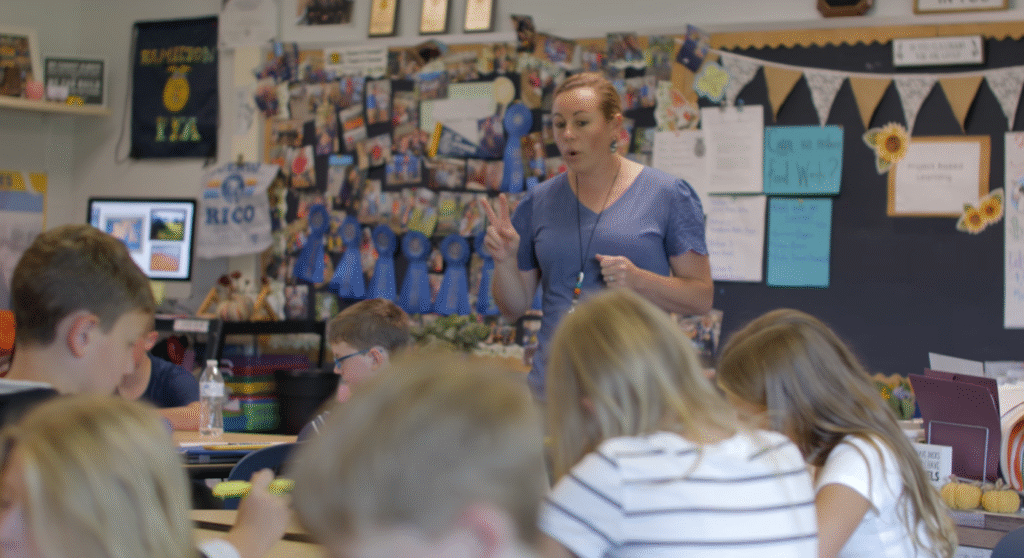
To take the lessons they’re learning through the Dairy Drive a step further, Monica signed up for the Adopt a Cow program two years ago. Her goal was for students to get a deeper look at dairy farms and how milk is produced by being paired with a calf from a working dairy farm.
“I’ve done the Adopt a Cow program for two years, and I absolutely love it so much. I have used it in a variety of ways. We do have a lot of farming around us, but the majority of our population has no idea where their food comes from. Many of them don’t know the milk that’s in their carton is coming from a cow,” she explained. “Maybe we can’t physically visit our adopted calf through the program, but we can go to Collins Creamery and make the connections.”
With photos and virtual updates provided through the Adopt a Cow program, Monica’s students are learning about how fast cows grow, career opportunities in agriculture, and how milk goes from the farm to the table – or in their case, their local food cupboard.
“The Adopt a Cow program helps us talk about the milk process and how it goes from cow to carton. We’ve been able to use our calf to make those connections,” Monica added. “Students love the updates and seeing the pictures. We talk about how our calf is so cute, but one day she’s going to start producing milk. I love bringing agriculture into my classroom because it is such a great learning tool for so many different elements.”
—
The Adopt a Cow Program is now open for enrollment for the 2025 school year! Click here to learn more and adopt a cow for your classroom today. The program, which impacted more than 1.7 million students last school year, is free thanks to support from Discover Dairy partners and donors.
Discover Dairy is an educational series managed by the Center for Dairy Excellence Foundation of Pennsylvania in partnership with American Dairy Association Northeast, American Dairy Association Indiana, Midwest Dairy, The Dairy Alliance, Dairy Farmers of Wisconsin, Dairy Management West, Dairy West, New England Dairy, Dairy Farmers of Washington, American Dairy Association Mideast, Dairy Council of Florida, United Dairy Industry of Michigan, Maine Dairy and Nutrition Council, and Oregon Dairy Council.
Meet Dave: Ohio Teacher Who’s Inspiring the Teachers of Tomorrow
This story is part of a series of “meet & greets” with individuals who use our Adopt a Cow program to inspire you with the endless ways you can incorporate the program in the classroom and beyond!
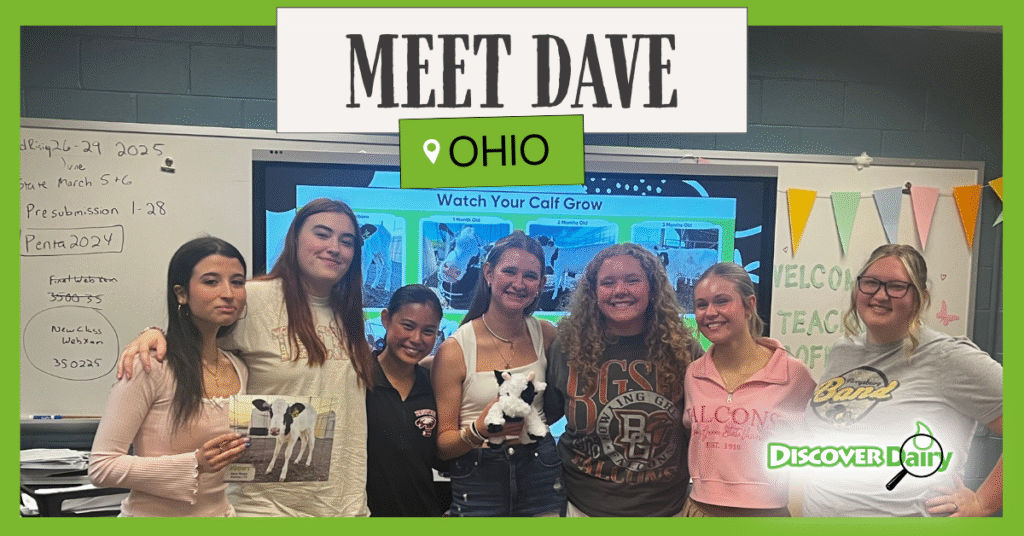
While teaching students is important, educating the future teachers who will one day serve these students is equally meaningful – especially with labor challenges across most of the country. That’s what Dave Harms’ role is all about: he is teaching future teachers (11th and 12th graders) in Northwest Ohio.
“I work with students who want to become teachers and offers a full year of college education classes to high school juniors and seniors. We have high schoolers commuting from 16 different school districts, and we teach four college classes,” he explained. “They go out to teacher placements, get into the classroom, and see different things – such as special education, elementary, junior high, and high school settings. We want to make sure they find the right category, and then they get to choose where they’re at for their senior year.”
As Dave began interacting with these future teachers, he was looking for activities that would help prepare them for working in the elementary school setting.
“I researched activities to help prepare students for elementary teaching, and the Adopt a Cow program was suggested. We jumped in and did it, and we had a great time,” Dave shared. “It was nice to share the learning activities that go along with the program and discuss how fun activities embedded in the curriculum can embellish academic content in the elementary classroom.”
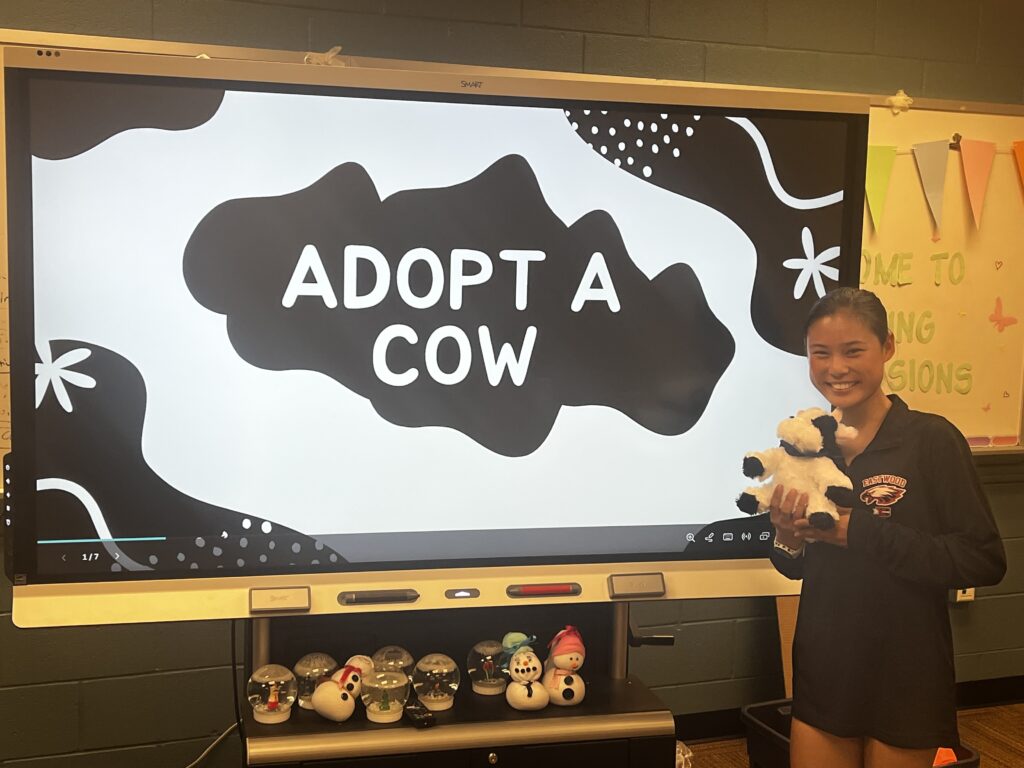
Through Discover Dairy’s Adopt a Cow program, students are paired with a calf from a nearby dairy farm – learning all about her growth, the dairy farm itself, how milk is produced, and more through regular updates, activity sheets and resources. For Dave, several components of the Adopt a Cow program have helped his students during their placements in local elementary schools.
- Dairy-themed resources and activities. “Every other week, we received an email that had different dairy lessons and activities. Nine of my students were going to elementary schools on a regular basis, so they took some of the activities and shared it with the teachers they worked with.”
- America’s Favorite Calf election. “We had our recruitment week with area schools, and we had to give a 20-minute presentation to all 16 member schools. That was during the week of the national election and the program’s ‘America’s Favorite Calf’ mock election. We incorporated our adopted calf, Peony, into our presentation and she ended up winning the mock election.”
- Live chat and lesson plans. “We did the virtual live chat with our calf. We were able to see all the different schools and see what types of questions the elementary kids were asking. We pulled up some sample lesson plans that the program sent out and went over them.”
- New connections. “In Northwest Ohio, most of my students don’t have any experience with actual cows or how much feed they get. When we watched the videos and learned what they were eating or about the different grains, they found it to be very fascinating.”
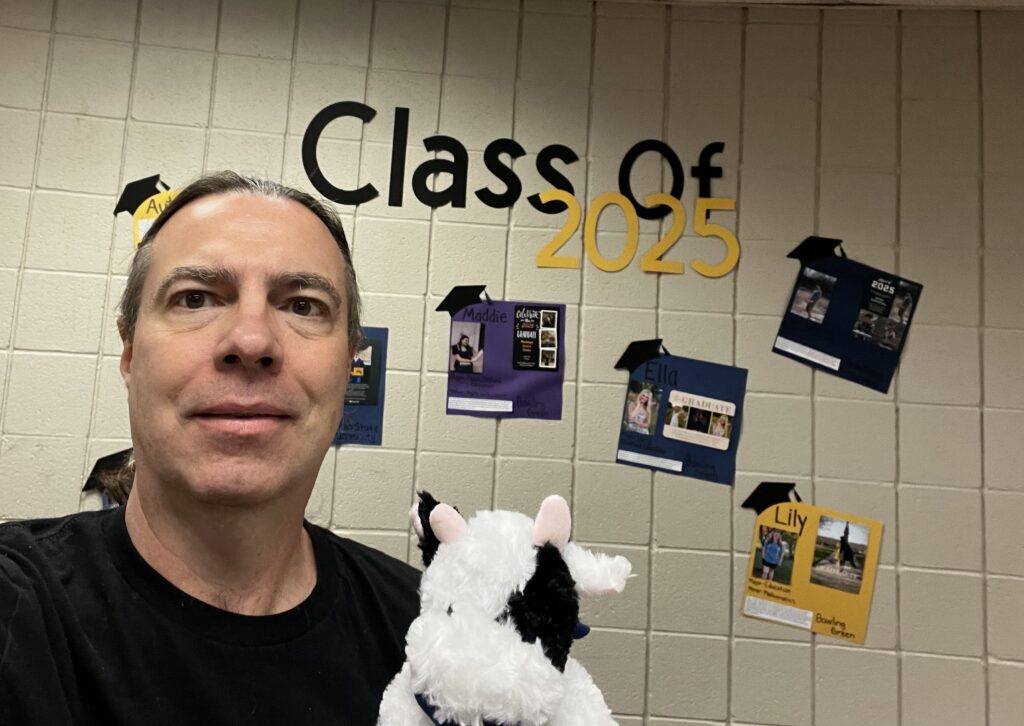
Dave’s students are highly motivated and passionate about becoming teachers, so the Adopt a Cow Program has given them leadership skills and something concrete they can bring with them into their placements at elementary schools.
“The students have to get [accepted] into college before they can even be in our program, so they’re very serious about being educators. The Adopt a Cow program allows them to go directly into the class and tell their mentor teacher, ‘Hey, I’ve got this program. I’ll run it.’ It gives them a leadership role and allows them to help the teacher out, too,” Dave added.
By investing in the teachers of tomorrow, Dave’s program is also helping with his community’s teacher shortage.
“We have such a teacher shortage that’s going on here. One of my students already got a job offer at her home school [after she receives her certifications],” he explained. “Being able to work with these students who are all so excited about becoming teachers and passionate about helping people has been an amazing change for me. It has reinvigorated me. I like to think I’m just hanging on for the ride. I provide them the opportunities to do things [like the Adopt a Cow program] and they take off and run with them.”
—
The Adopt a Cow Program is now open for enrollment for the 2025 school year! Click here to learn more and adopt a cow for your classroom today. The program, which impacted more than 1.7 million students last school year, is free thanks to support from Discover Dairy partners and donors.
Discover Dairy is an educational series managed by the Center for Dairy Excellence Foundation of Pennsylvania in partnership with American Dairy Association Northeast, American Dairy Association Indiana, Midwest Dairy, The Dairy Alliance, Dairy Farmers of Wisconsin, Dairy Management West, Dairy West, New England Dairy, Dairy Farmers of Washington, American Dairy Association Mideast, Dairy Council of Florida, United Dairy Industry of Michigan, Maine Dairy and Nutrition Council, and Oregon Dairy Council.
Meet Maryssa: Texas Elementary Teacher Who Supports Students With Agriculture Therapy Program
This story is part of a series of “meet & greets” with individuals who use our Adopt a Cow program to inspire you with the endless ways you can incorporate the program in the classroom and beyond!
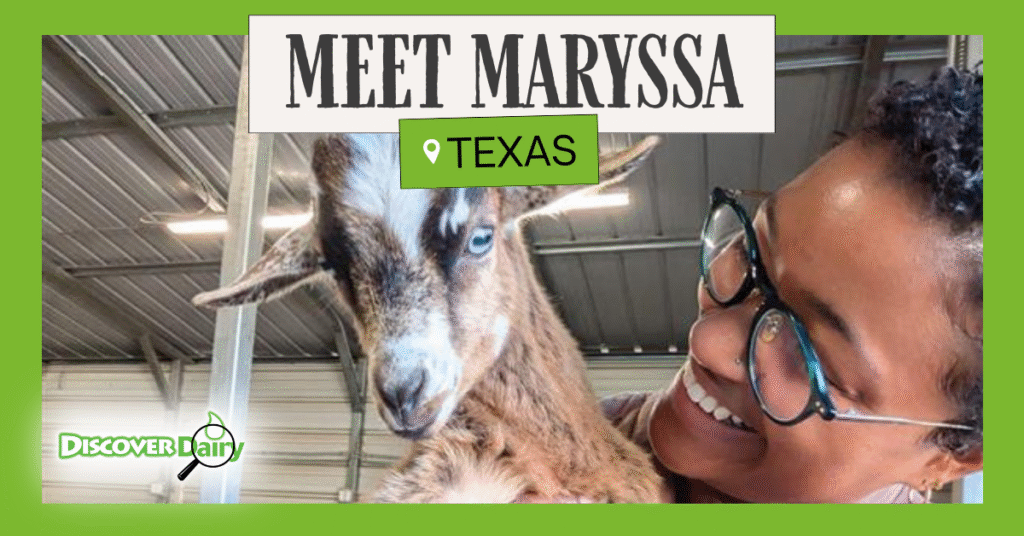
Maryssa Adams teaches pre-k through 5th grade in a Title 1, urban school district in Texas. After noticing increasing levels of stress, anxiety and behavioral issues in students, her campus decided to create an agriculture therapy program. Discover Dairy’s “Adopt a Cow” program was the perfect complement to some of the concepts they teach students through the ag therapy program.
We sat down for a quick Q&A with Maryssa to learn more about how agriculture education is empowering her students.
How did the ag therapy program come about?
It all started with my love for animals and having been privileged enough to experience the healing they bring firsthand. The increasing levels of stress, anxiety, and behavioral issues in students was also something that we just couldn’t ignore. Our campus has always been really big about supporting the “whole child” and emphasizing the importance of social and emotional development. It just seemed like tactile and experiential learning was the way to help kiddos truly thrive.
What does the program involve?
Gardening and Plant Care: Students plant, water, weed, and harvest fruits, vegetables, herbs, and flowers. Children learn about life cycles, seasons, and sustainability.
Animal-Assisted Activities: Interaction with small farm animals (e.g., chickens and goats) Doing daily care tasks like water, food, habitat upkeep to teach empathy, responsibility, compassion, and caregiving.
Many tasks are done in pairs or small groups to foster communication, cooperation, and shared responsibility.
How are students benefitting from the ag therapy program?
Working with plants and animals improves empathy, responsibility, and teamwork. These are foundational skills for emotional intelligence and future success.
Students have shown an enhanced self-esteem and a sense of accomplishment, along with resilience and patience, through nurturing living things. Stress and anxiety has been reduced with nature based activities having calming effects, helping students feel more relaxed and focused.
There are also numerous academic benefits such as boosting engagement, enhancing understanding, making learning more meaningful and memorable, and supporting differentiated learning.
How does the Adopt a Cow program connect to what you’re doing in the ag therapy program?
We started with a welcome party where students got to “meet” our adopted cow, Aspen. The biggest piece was, with each growth update, we connected to how all living things grow and experience change. Seeing Aspen grow throughout the year was huge in helping our students reflect on their own personal growth.
Additionally, students began to understand what Aspen needs to thrive, and realized that we are not so different when it comes to food, safety, care, etc. This was the first year for us using the program, but it won’t be the last. We loved it!
Were there any creative ways you incorporated the Adopt a Cow program into the classroom? Any fun memories your students made?
We had a Meet Your Cow Day, where we shared photos, fun facts, etc. and let students write letters, draw pictures, and create a sort of “Cow Diaries”. We used this regularly for students to reflect on what they learned, express how they felt about the update, take note of something they noticed or wondered, etc.
My interactive bulletin board was a favorite, too. Students would submit guesses on calf growth, submit questions, make artwork (my calf and me), etc.
I also laminated photos of Aspen for students to keep in their self-regulation folder. It was honestly the best seeing them pull it out, look at it, take a deep breath, and calm themselves down.
Why do you think it’s important for students to learn about agriculture and where their food comes from?
When students understand how food is grown and produced, they’re more likely to make informed, healthy choices. They begin to appreciate the value of fresh, whole foods and are more willing to try fruits and vegetables—especially ones they’ve grown themselves.
Learning where food comes from fosters gratitude for farmers, animals, and the natural processes that sustain us. It teaches respect for the hard work and time involved in growing and producing food—not just grabbing it off a shelf.
Agriculture naturally integrates science, math, reading, and social studies into real-world contexts. It answers kids’ common question: “Why do I need to learn this?”—by giving them practical, meaningful examples.
As issues like climate change, food security, and sustainability become more critical, students who understand agriculture will be better equipped to contribute solutions.
It can also spark interest in future careers in science, environmental studies, nutrition, veterinary care, and beyond.
Agriculture education isn’t just about farming — it’s about empowering kids to understand, respect, and engage with the world around them in a thoughtful, grounded way.
—
The Adopt a Cow Program is now open for enrollment for the 2025 school year! Click here to learn more and adopt a cow for your classroom today. The program, which impacted more than 1.7 million students last school year, is free thanks to support from Discover Dairy partners and donors.
Discover Dairy is an educational series managed by the Center for Dairy Excellence Foundation of Pennsylvania in partnership with American Dairy Association Northeast, American Dairy Association Indiana, Midwest Dairy, The Dairy Alliance, Dairy Farmers of Wisconsin, Dairy Management West, Dairy West, New England Dairy, Dairy Farmers of Washington, American Dairy Association Mideast, Dairy Council of Florida, United Dairy Industry of Michigan, Maine Dairy and Nutrition Council, and Oregon Dairy Council.
Meet Andrea: Illinois High School Teacher Who’s Helping Students Overcome Failed Classes While Building Real Connections With Dairy Farmers
This story is part of a series of “meet & greets” with individuals who use our Adopt a Cow program to inspire you with the endless ways you can incorporate the program in the classroom and beyond!
Andrea Napier, a high school teacher from Illinois, has a challenging, but rewarding role: she helps high school students who fail certain courses recover their credits and walk across the graduation stage. She teaches students who are 14-18 years old in all general subjects – from algebra and science to English, social studies and elective courses.
“One student could be taking health this week, and next week they could be doing an elective. We monitor their progress. I talk with them [when they start my class] and I give them a minimal percentage in order for them to pass the course by the end of the school year,” Andrea shared.
While she has been helping students overcome their failed classes, she has also found a unique way to help them build real connections with dairy farmers – and each other – through Discover Dairy’s Adopt a Cow program. The program allowed them to “adopt” a calf from a nearby dairy farm.
“We started the Adopt a Cow program, which I learned about through another teacher. I thought the program could help me build somewhat of a relationship with my students and give them chances to talk in front of the class, since I really don’t get to do that in this setting,” Andrea explained. “This was just my second year using the program, but I really like it and the kids really like it.”
One of the ways the program has helped her students build connections, and express themselves in front of the class, is by sparking important conversations and memories about agriculture in their community.
“The program makes it easy to engage with students. Some kids will tell stories. One student described what he experienced visiting his grandma’s farm and how she would milk cows,” Andrea said. “The first year we did the program, we had a student whose family has a dairy farm. She talked to my class about what she does and how there’s never a day off from work. She also named a couple local pizza places in our area that buy their cheese from her farm. It was very interesting for students to hear that from a peer.”
The Adopt a Cow program has also helped Andrea’s students connect with real farmers and gives them a more tangible way to ask real-time questions. Andrea has found this especially valuable with the rapid advancement of technology that makes it difficult for students to actually connect.
“A lot of high schoolers just want AI to tell them the answers – instead of hearing firsthand experiences from someone else and spending time talking about it,” Andrea added. “The Adopt a Cow program gives them a little more knowledge. When we connect to a cow and share examples with them, I think it’s more meaningful to students. It’s more real and tangible. Kids will raise their hand and bring things up. They’ll chime in on experiences they’ve had.”
Along with conversation and connection, Andrea incorporated some of the program’s dairy-themed activities into her class once a month. They also tuned in to the Adopt a Cow live chat, where they had the chance to virtually meet their adopted calf and host farm.
As Andrea makes deliberate time to motivate and connect with every one of her students throughout the year, the ultimate reward is when they walk across the graduation stage and overcome the challenges they faced.
“Any teacher could probably tell you that there are some days when you go home and wonder if you’re doing enough for these kids. Another teacher helped me realize that you have to start developing relationships with them and get them to start talking to you. It’s so true. I could easily have behavior issues in my room, but I really don’t, because I talk to them or I pull them out in the hall and reason with them,” she added. “And when I see the reward of them getting their diploma, I’m really thrilled. They listened, did what they needed to get their credit back, overcome their mistakes, and graduated and moved forward from there.”
—
The Adopt a Cow Program is now open for enrollment for the 2025 school year! Click here to learn more and adopt a cow for your classroom today. The program, which impacted more than 1.7 million students last school year, is free thanks to support from Discover Dairy partners and donors.
Discover Dairy is an educational series managed by the Center for Dairy Excellence Foundation of Pennsylvania in partnership with American Dairy Association Northeast, American Dairy Association Indiana, Midwest Dairy, The Dairy Alliance, Dairy Farmers of Wisconsin, Dairy Management West, Dairy West, New England Dairy, Dairy Farmers of Washington, American Dairy Association Mideast, Dairy Council of Florida, United Dairy Industry of Michigan, Maine Dairy and Nutrition Council, and Oregon Dairy Council.
Meet Rylee, Elementary Teacher From Idaho with Passion for Agriculture
This story is part of a series of “meet & greets” with individuals who use our Adopt a Cow program to inspire you with the endless ways you can incorporate the program in the classroom and beyond!
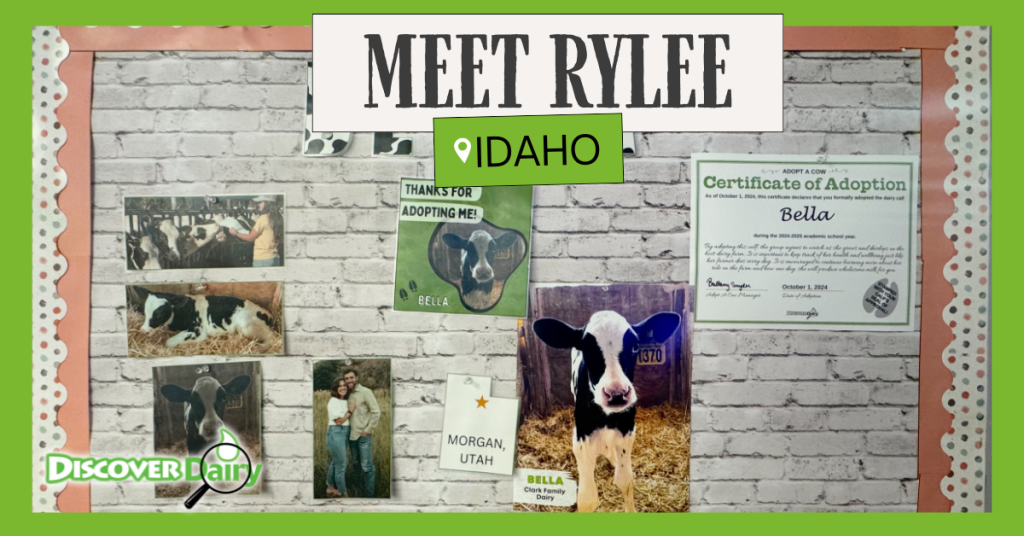
Rylee Murdoch teaches third grade (soon to be fourth grade) in Idaho Falls, Idaho. After growing up on a beef cattle ranch, she has always been passionate about introducing her students to the world of agriculture. When she heard about Discover Dairy’s Adopt a Cow Program, she knew she wanted to sign up her classroom. We sat down with her for a Q&A on how she utilized the program with her elementary students.
Why did you decide to sign up for the Adopt a Cow program?
I saw a video on TikTok and knew I had to sign up. I grew up on a beef cattle ranch so I thought it would be fun to incorporate agriculture into my classroom. This is only my first year teaching.
What grade do you teach?
I teach 3rd grade. We have a wide range of demographics. We have very nice neighborhoods all the way to a couple of homeless shelters in our school boundaries.
What was your favorite part of the program?
I loved having a class pet without having to take care of it. We did a lot of writing reflections about our cow, Bella. Discovery Dairy was so fun to have in my classroom! I am moving up to fourth grade next year, and my students have been asking if I am doing it again. They absolutely loved it!
Why is it important to teach students where their milk and food comes from?
When I was in high school in an agricultural class, we called numbers located in big cities. We asked them questions like, “Where do we get chocolate milk?” We were baffled by their answers. I grew up around agriculture and I think that even if kids don’t, they should be educated about agriculture and dairy farming.
—
The Adopt a Cow Program is now open for enrollment for the 2025 school year! Click here to learn more and adopt a cow for your classroom today. The program, which impacted more than 1.7 million students last school year, is free thanks to support from Discover Dairy partners and donors.
Discover Dairy is an educational series managed by the Center for Dairy Excellence Foundation of Pennsylvania in partnership with American Dairy Association Northeast, American Dairy Association Indiana, Midwest Dairy, The Dairy Alliance, Dairy Farmers of Wisconsin, Dairy Management West, Dairy West, New England Dairy, Dairy Farmers of Washington, American Dairy Association Mideast, Dairy Council of Florida, United Dairy Industry of Michigan, Maine Dairy and Nutrition Council, and Oregon Dairy Council.
Meet Eva: Bus Driver From Southwest Ohio Who Adopted a Cow for Her Bus
This story is part of a series of “meet & greets” with individuals who use our Adopt a Cow program to inspire you with the endless ways you can incorporate the program in the classroom and beyond!
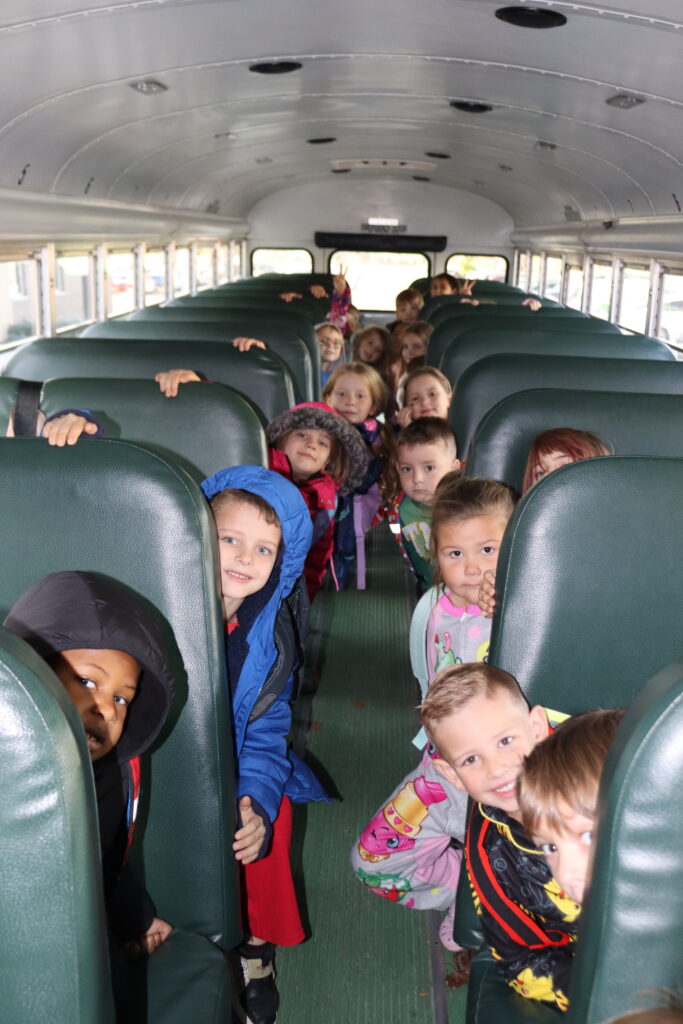
Eva Cundiff, a bus driver for West Carrollton City Schools in Southwest Ohio, has multiple bus routes and everyone from preschoolers to twelfth-graders on her bus in a given week. So, how does she engage students that she might only see for a few minutes a day?
“I’ve been a bus driver since 1995. Through the years of driving, things have changed. Your normal home life in 1995 is nowhere near what it is now. The money’s not there for food. In our district, we’re fortunate that every child gets free breakfast and free lunch. But our kids need structure. So if I can help one kid smile in a day, I’m going to do it,” she shared.
By providing this structure and a friendly face, she hopes it makes her bus a fun and inviting place for students. Eva also describes it as a “mobile classroom,” where she can make meaningful connections and learning moments with students. That’s what inspired her to try out Discover Dairy’s “Adopt a Cow” program for her bus.
“During the summer, I typically give out ice cream or different things. I also have a newer bus that has Bluetooth, so I create playlists and the kids all enjoy singing songs and having a great time. Anytime I take a group of kids on a field trip, I always try and go in with them, too. With my bus already being kind of like a mobile classroom, I thought we could adopt a cow and try to gear it towards the bus.”
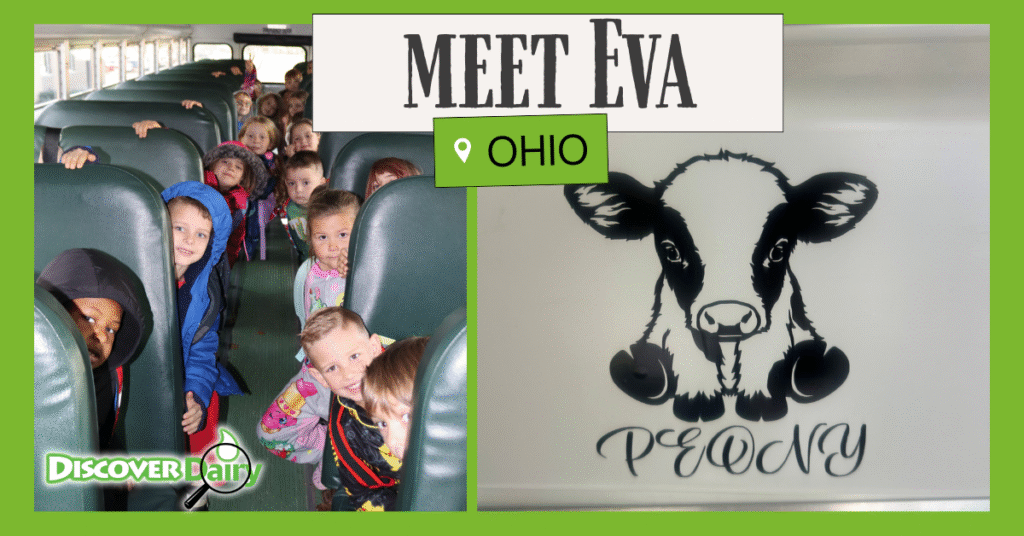
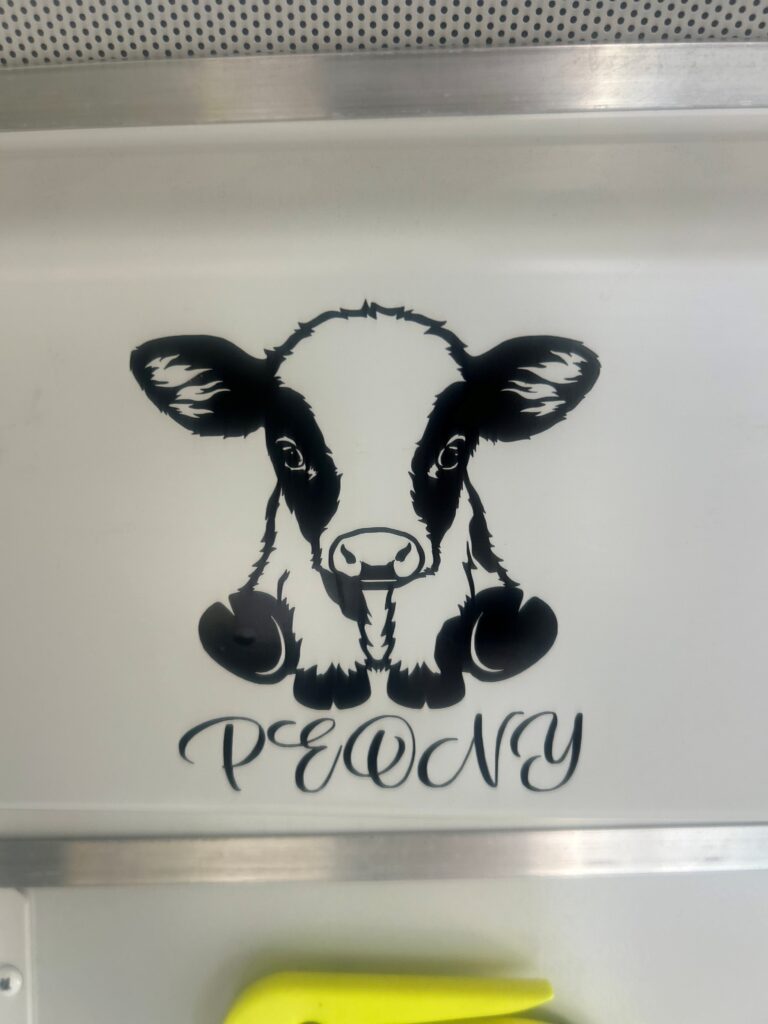
To display the adopted cow prominently on her bus, Eva decided to get a personalized decal with their calf, Peony, so the kids could see her every day. She also offered the program’s coloring sheets to her students as a take-home activity and shared dairy snacks like cheese sticks and yogurt pouches. Eva also thought outside the box when it came to group activities like butter-making – and how she could make them work in a bus setting.
“I wanted to get heavy cream, put it in a plastic container with a lid, let the kids pass it around on the bus, and take turns shaking it the whole time we’re driving to see if they can see it start clumping up to make butter,” Eva shared. “That way, everybody gets to do something. I’d have it finished up by the end of the day when they come back on the bus in the afternoon and they would get to see that it did turn into butter.”
With many of her students coming from low-income backgrounds, Eva finds it important to teach students where their food comes from and help address food insecurity in a small way.
“I think it’s important to teach students these lessons, especially because of the fact that food is so expensive and not every family has access to it. If they’re learning where it comes from, maybe they might think about what they could do when they grow up and help feed their family,” she added.
Eva has also used the limited time she has with students each day, and the material provided through the Adopt a Cow program, to teach important lessons about nutrition and the world.
“My kids know how to sit and behave because I have expectations for them to keep them safe. I figure while I’ve got their attention and I can mold their minds, why not start instilling ideas about healthy choices? We need to look out for healthy foods to keep our bones strong,” Eva shared.
The Adopt a Cow Program is now open for enrollment for the 2025 school year! Click here to learn more and adopt a cow for your classroom today. The program, which impacted more than 1.7 million students last school year, is free thanks to support from Discover Dairy partners and donors.
Discover Dairy is an educational series managed by the Center for Dairy Excellence Foundation of Pennsylvania in partnership with American Dairy Association Northeast, American Dairy Association Indiana, Midwest Dairy, The Dairy Alliance, Dairy Farmers of Wisconsin, Dairy Management West, Dairy West, New England Dairy, Dairy Farmers of Washington, American Dairy Association Mideast, Dairy Council of Florida, United Dairy Industry of Michigan, Maine Dairy and Nutrition Council, and Oregon Dairy Council.
Meet Naomi: Fifth-Grade Special Education Teacher in Connecticut
This story is part of a series of “meet & greets” with individuals who use our Adopt a Cow program to inspire you with the endless ways you can incorporate the program in the classroom and beyond!
Naomi Niemann may have grown up on a dairy farm, but not all of her students are familiar with what farmers actually do and where their food comes. Naomi decided to sign up for Discover Dairy’s Adopt a Cow program and introduce some of these concepts to her fifth-grade special education students in Mansfield, Connecticut.
“I grew up on a dairy farm when I was a child, so I naturally just love cows. I saw the program and I thought, what a fun way to bring some engagement material to students and have a cow they can follow along with,” she shared. “I work with students of lower socioeconomic status given my position. They don’t have a lot of exposure to where their food comes from, and I think that’s essential as we grow. Where do our things come from and how do we get these things? That’s a big focus of what I instructed on [with the Adopt a Cow program].”
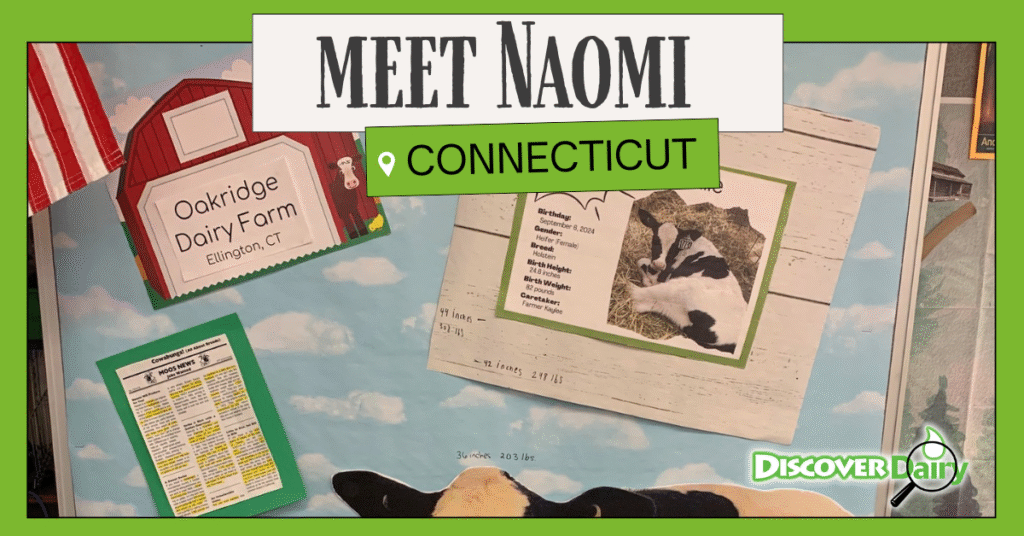
After being paired with Oakridge Dairy, a dairy farm about 30 minutes away from most of her students, Naomi was able to spark community connections with her classroom.
“The kids were really excited when they realized that because our farm was fairly close, they have actually seen the products from the farm in the stores around us,” she added.
The Adopt a Cow program not only provides regular updates about their adopted calf and host farm throughout the year, but it has several lessons, videos and activities that bring careers in agriculture to life for students.
“Some of the materials that were given were really helpful in looking at different jobs around the farm. We do a lot of career exploration, so we could do investigatory research on those agriculture career paths and what kind of education people need,” Naomi shared.
When it came to specific subject areas, the Adopt a Cow program helped Naomi strengthen some of the math lessons she was teaching. For example, as her students learned about the different breeds of dairy cows, they were able to practice comparing and contrasting skills. When they chatted directly with dairy farmers, she says they were able to learn more about data prediction.
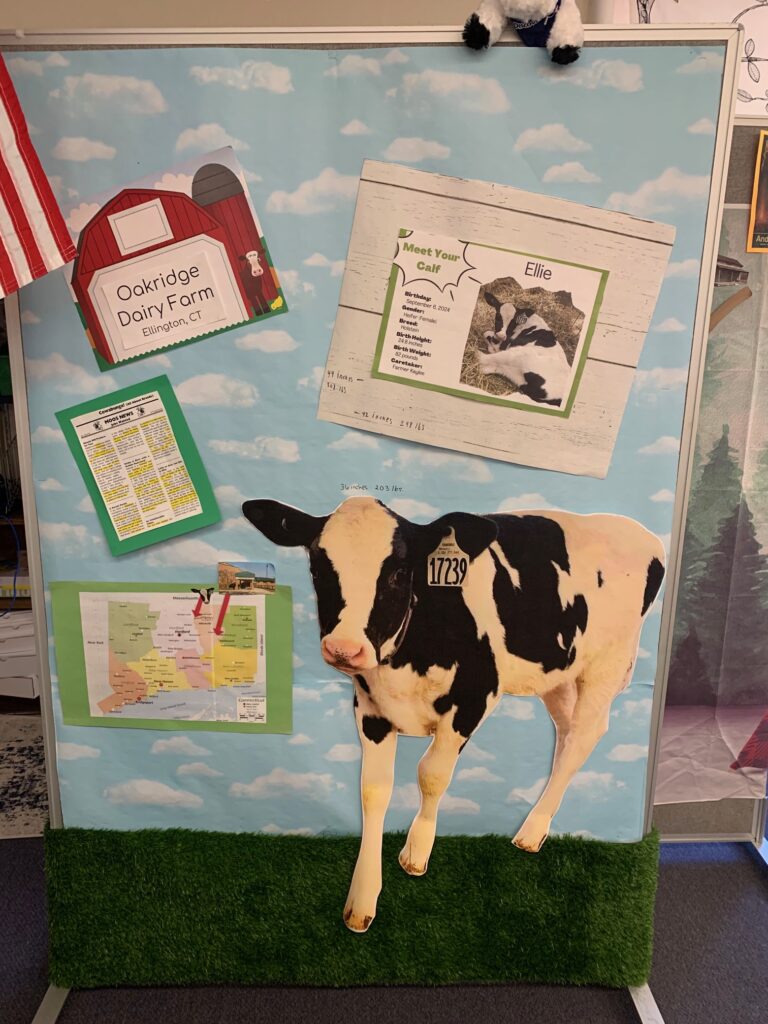
“I took some of the items from the program and aligned them with the content and targeted skills we were working on. When we asked our farmers questions, we used their answers to help us make more accurate, data-driven predictions,” she explained. “When our calf was three months old, our media specialist made a life-size cow for us along with a pasture for her on one of our movable bulletin boards. The kids could get the tape measure out and mark her growth on the growth chart [that the program provided]. One student was working on linear graphs and prediction, while others tried to make the measurements. The key was, the cow helped promote students’ engagement with those subject areas.”
Overall, the anticipation for their adopted calf’s updates and how fast she was growing kept Naomi’s students engaged and excited all year long.
“The kids really loved getting the calf updates. If I delayed [sharing] the cow update for a day or two, they would get really disappointed with me. So it definitely promoted their engagement,” she added.
The Adopt a Cow Program is now open for enrollment for the 2025 school year! Click here to learn more and adopt a cow for your classroom today. The program, which impacted more than 1.7 million students last school year, is free thanks to support from Discover Dairy partners and donors.
Discover Dairy is an educational series managed by the Center for Dairy Excellence Foundation of Pennsylvania in partnership with American Dairy Association Northeast, American Dairy Association Indiana, Midwest Dairy, The Dairy Alliance, Dairy Farmers of Wisconsin, Dairy Management West, Dairy West, New England Dairy, Dairy Farmers of Washington, American Dairy Association Mideast, Dairy Council of Florida, United Dairy Industry of Michigan, Maine Dairy and Nutrition Council, and Oregon Dairy Council.